Mapping Copy Trading to Your Retirement Timeline: A Strategy for Every Stage of the Journey
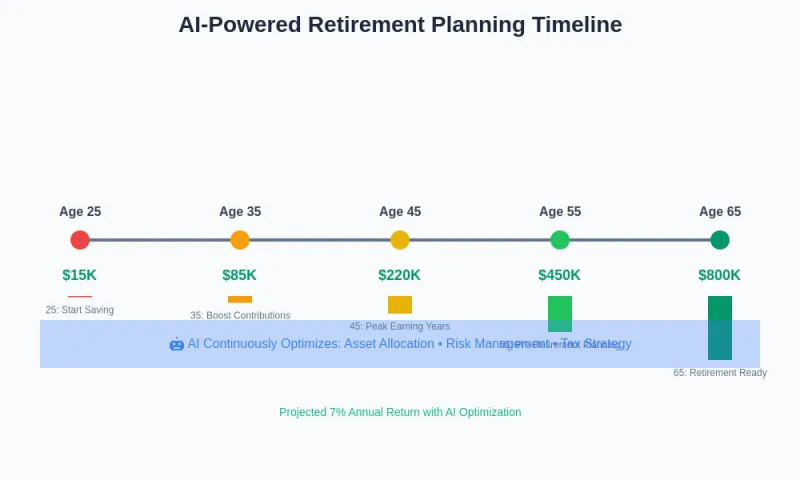
Photo: retirement planning investment strategy financial growth timeline, via ai.devtheworld.jp
The American retirement landscape has changed dramatically over the past three decades. The near-universal shift from defined-benefit pension plans to self-directed 401(k) accounts has transferred both the opportunity and the burden of wealth accumulation squarely onto individual investors. For many, that transition has been disorienting. For others, it has opened the door to investment approaches that would have been inaccessible to retail participants in previous generations — including copy trading.
Copy trading, at its core, allows individual investors to replicate the positions of vetted professional traders in real time. But the way a 26-year-old software engineer in Austin should use this tool looks nothing like the way a 58-year-old school administrator in Ohio should. Time horizon, risk capacity, income needs, and tax situation all shape the appropriate role that copy trading should play in a retirement strategy. This guide examines each major life stage in turn.
The Early Accumulation Years: Ages 22 to 35
For investors in their twenties and early thirties, time is the most powerful asset on the balance sheet. Compound growth over a 35- to 40-year horizon can transform modest annual contributions into substantial retirement wealth. This stage is defined by high risk capacity — not because young investors can afford to lose money, but because they have sufficient time to recover from temporary setbacks and benefit from subsequent market cycles.
Within a retirement-oriented portfolio at this stage, copy trading can reasonably occupy a meaningful allocation. A practical framework might allocate 60 to 70 percent of investable assets to low-cost index funds within tax-advantaged accounts such as a Roth IRA or employer-sponsored 401(k). The remaining 30 to 40 percent, held in a taxable brokerage account, can be directed toward copy trading strategies with a growth orientation.
At this stage, investors should actively seek traders who employ higher-conviction, higher-volatility strategies — those targeting emerging sectors, small-cap equities, or international growth markets. The volatility is acceptable because the time horizon absorbs it. What matters most is identifying traders with demonstrable discipline: consistent risk management, transparent drawdown histories, and strategies grounded in repeatable logic rather than short-term momentum chasing.
Case study: A 28-year-old investor in Chicago began allocating $500 per month to copy trading in 2021, selecting three traders with distinct sector focuses — one in renewable energy, one in biotech, and one in international emerging markets. Over three years, despite significant volatility in each sector individually, the portfolio's diversified structure produced annualized returns of approximately 14 percent, meaningfully outpacing the investor's index fund allocation during the same period. The key was not chasing the top-performing trader but maintaining a diversified, long-horizon approach.
The Mid-Career Inflection Point: Ages 36 to 50
Mid-career professionals often face a paradox: their income is at or near its peak, but so are their financial obligations — mortgages, college savings for children, aging parents, and escalating lifestyle costs. This is also the stage at which retirement begins to feel tangible rather than abstract, making the balance between growth and capital preservation increasingly important.
For investors in this range, copy trading should begin to take on a more structured role within a deliberately tiered portfolio. A reasonable framework allocates the core retirement savings — typically 70 to 80 percent of total investable assets — to a blend of diversified index funds and target-date funds within tax-advantaged accounts. Copy trading, housed in a separate taxable account, can represent 15 to 25 percent of overall allocation.
Critically, the strategy selection criteria should evolve. Mid-career investors should prioritize traders with Sharpe ratios above 1.0, maximum drawdown histories below 20 percent, and strategies that incorporate some degree of downside protection. Pure momentum traders who have delivered explosive short-term gains but exhibit deep drawdown patterns are appropriate for the early accumulation phase — less so for investors who are now 15 to 20 years from retirement.
This is also the stage at which tax efficiency becomes a meaningful consideration. Frequent trading within copy portfolios can generate substantial short-term capital gains, which are taxed at ordinary income rates. Mid-career investors should work with a tax professional to understand the implications and, where possible, structure their copy trading activity to minimize unnecessary tax drag.
Case study: A 44-year-old financial analyst in Atlanta restructured her copy trading allocation after reviewing her portfolio's tax liability. By shifting to traders with longer average holding periods and lower turnover rates, she reduced her annual tax bill on copy trading gains by approximately $3,200 — effectively adding that amount back to her net returns without changing her risk profile.
The Pre-Retirement Decade: Ages 51 to 62
For investors within ten years of their target retirement date, the calculus shifts decisively toward capital preservation and income generation. This is the stage most vulnerable to what financial planners call "sequence of returns risk" — the danger that a significant market decline in the years immediately before or after retirement can permanently impair a portfolio's ability to sustain withdrawals throughout a 20- to 30-year retirement.
Copy trading does not disappear from the strategy at this stage, but its role contracts significantly. A prudent allocation might limit copy trading to 10 to 15 percent of total investable assets, concentrated exclusively in traders with conservative, income-oriented strategies — dividend-focused equity traders, options income strategies, or fixed-income specialists.
Investors in this cohort should be particularly vigilant about avoiding the performance-chasing behavior that leads many to overallocate to high-volatility traders based on recent returns. A trader who delivered 80 percent returns in a bull market may be entirely inappropriate for an investor whose primary objective is protecting the wealth they have already built.
Case study: A 59-year-old retired military officer in Virginia allocated 12 percent of his portfolio to a copy trading strategy focused on dividend-paying equities and covered call income strategies. Over a two-year period, this allocation generated an annualized return of approximately 9.4 percent with a maximum drawdown of 7.2 percent — providing meaningful income contribution without exposing his near-retirement portfolio to the volatility he could no longer afford.
Principles That Apply at Every Stage
Regardless of age or time horizon, several foundational principles govern effective integration of copy trading into retirement planning.
Never allocate retirement funds you cannot afford to lose. Copy trading, like any active investment strategy, carries real risk. The allocation that belongs in copy trading is money that exists outside your core retirement safety net — not inside it.
Rebalance annually. As copy trading positions grow or contract relative to your broader portfolio, periodic rebalancing ensures that your overall risk exposure remains aligned with your current life stage and objectives.
Evaluate traders on risk-adjusted performance, not raw returns. A 30 percent annual return that came with a 40 percent drawdown is a very different proposition than a 15 percent return achieved with a 10 percent drawdown. For retirement-oriented investors, consistency and capital protection matter as much as upside.
Building a Retirement You Control
At Garuda Copy Trade, our conviction is that copy trading is not a shortcut to retirement wealth — it is a precision instrument that, properly calibrated to your timeline and risk profile, can meaningfully enhance the trajectory of a well-structured retirement plan. The investors who use it most effectively are those who treat it as one component of a deliberate, stage-appropriate strategy rather than a standalone solution.
Your retirement timeline is unique. Your copy trading strategy should be too.